
00 / Case study / teardown
How a product went from 15,000 to 516,000 total search impressions in about 7 weeks
By Beamcite. No ads, no bought backlinks. The company is anonymized at the client’s request.
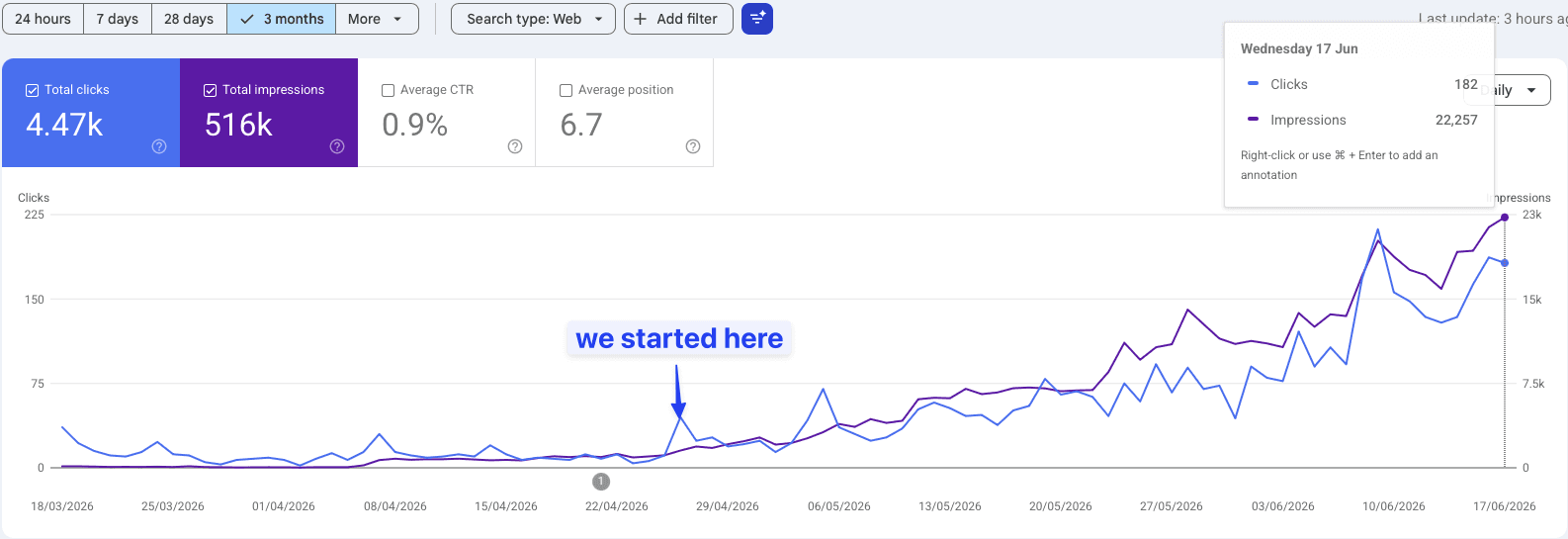
TL;DR. A product we worked with had about 15,000 total search impressions. About seven weeks later it was at 516,000, roughly 34x, with no paid ads and nothing bought. About 76% of clicks now come from blog content that did not exist before. The growth came from four steps run in order: find the questions worth answering from data the business already had, rewrite pages so AI answer engines can quote them, get mentioned on other sites so AI starts citing the product, and publish on a cadence so the cluster compounds.
34x
impression growth in ~7 weeks
76%
of clicks from new content
ChatGPT
product now cited as a source
The first thing worth saying: none of this was clever. There was no growth hack and no trick. It was four steps, done in order, and then patience while the curve did nothing for a while.
One warning before the steps. Two of these four are things you have heard a hundred times: write to the question, make pages answer-first. They are table stakes, not the edge. The step that actually moved the needle, the one almost nobody is doing, is Step 3: getting cited by AI because of what other sites say about you. If you only have two minutes, skip to Step 3.
Step 1
Find the questions worth answering
The mistake most people make is brainstorming topics. We did not invent a single topic. We pulled them from data the business already had, sitting unused in Google Search Console.
Two buckets matter. First, the queries the site was already getting impressions for but had no page actually answering. Those are questions the search already thinks the site is relevant to, with no content aimed at them. Second, the queries ranking somewhere around position 8 to 20, where a focused page can push you up. That export, sorted, became the entire content calendar.
Step 2
Rewrite pages so AI can quote them(the part you already know)
This is the step everyone writes about, so we will keep it short. An answer engine is not ranking your page, it is hunting for the cleanest passage it can lift. So every page got rewritten to lead with the answer: answer in the first two sentences, the literal question as the heading, one idea per section, a short summary up top. The single biggest change was killing the intro. That is genuinely most of the on-page work, and it is table stakes now, not an advantage. The advantage is the next step.
Step 3 / the one that actually worked
Get cited by AI for what other sites say about you
Here is the thing almost everyone gets wrong. The entire GEO conversation right now is about your own page: llms.txt, schema, answer-first formatting. All of that is Step 2. It is necessary and it is not enough.
Getting cited inside an AI answer depends heavily on what other sites say about you, often more than your own page does. An answer engine cross-checks before it names a source. If three credible sites already mention you in a roundup or directory, you become a safe thing to cite. If nothing off your domain mentions you, your perfectly answer-first page still does not get named, because the engine has no second opinion.
So the real work was getting the product mentioned off its own domain: directory listings, “best of” roundups, comparison posts. Once a handful of those existed, the product started turning up as a cited source in ChatGPT and Perplexity answers, not just in the blue links.
The proof that this is the lever, not the page.
We ran the same play for a boring, local, offline service business. No blog, no content engine, nothing to optimize on-page. We just got it mentioned in the right off-site places for its city and category.
Three months later it gets named by ChatGPT when someone asks for providers in its city, sitting right next to the big national directories. A business with effectively no website presence is now an AI-cited source. That only happened because of off-site mentions. There was no page to thank.
Step 4
Keep publishing, and let the wins build on each other
We did not write one perfect post. We published consistently. Most posts did nothing. A few caught a keyword cluster and pulled the rest up through internal linking, ranked pages lifting unranked ones. That is the flat-then-vertical curve at the top of this page. The growth looks like failure right up until it does not, which is exactly why the people who stop in week five never see it.
05 / FAQ
Frequently asked questions
How is this different from regular SEO?+-
Regular SEO optimizes to rank a link that a human clicks. This optimizes to be quoted as a source inside an AI answer, where there may be no click at all. The on-page work overlaps, but the deciding factor for AI citation, what other sites say about you, is mostly outside classic SEO's focus.
Did you buy backlinks or run ads?+-
No. No paid ads and no bought links. The off-site mentions were earned placements in directories, roundups, and comparison posts, the kind of listings that are legitimate to be included in, not link buys.
How long until it works?+-
Plan for a flat stretch of roughly four to eight weeks where almost nothing moves, then compounding. In both cases here, the real jump was month two to three, after the off-site signals existed for engines to weigh. The most common failure is quitting during the flat part.
Can I do this myself?+-
The on-page steps, yes, and you should. The off-site step is where it gets hard: knowing which directories and roundups actually move citations for your category, getting into them, and measuring whether AI is now naming you. That judgment and that legwork is the part most people cannot do at scale on the side, and it is what Beamcite does.
That is the whole process. The same four steps, every time.
Showing the steps is easy. Running them correctly, at scale, and actually measuring whether AI is citing you is the hard part, and it is what we do for clients. If you want that done for you instead of doing it yourself, that is Beamcite.
See how Beamcite worksNumbers are real and from a live client engagement; the company is anonymized at their request. Beamcite gets companies cited and recommended by AI answer engines like ChatGPT, Perplexity, and Gemini.